
 EN
EN  ES
ES  ZH
ZH  RU
RU  FR
FR  AR
AR 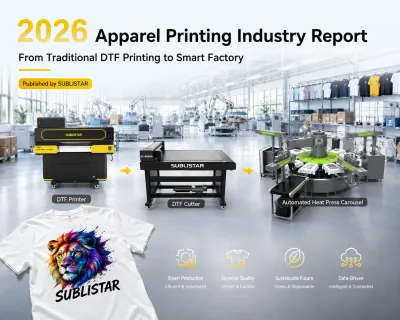

The apparel decoration industry is entering a new era of intelligent manufacturing. Traditional DTF printer production has dramatically improved digital garment decoration. However, rising labor costs, increasing demand for on-demand production, and advances in automation technologies are reshaping traditional DTF printing workflows. The combination of a DTF printer, DTF shaker (powder shaker & powder dryer), automatic cutting system, and automated heat press is becoming the foundation of next-generation smart apparel factories.
Based on SUBLISTAR’s research and practical experience in garment printing automation, this report examines the transition from traditional DTF production to smart factory workflows. It explores how AI vision systems, automated heat transfer, intelligent material handling, and integrated production lines are redefining productivity, consistency, and scalability in modern apparel decoration.
Table of Contents
In the past ten years, DTF printing has totally changed the textile industry. Compared to traditional screen printing, DTF printing has the following advantages:
- No need to make screens
- Realize small batch production
- Print on demand
- Full-color graphic output
- Support different kinds of fabrics
Therefore, more and more clothing manufacturers, brand owners, and print-on-demand companies began to use DTF printers. However, with the growing popularity of DTF printing, a new problem appeared: the printing speed of DTF printers has constantly grown, but overall production efficiency has not increased in proportion.
After conducting research, what limits production capacity is no longer the printing equipment itself but the manual operations after printing. Cutting film, heat transferring, and other follow-up and wrap-up work still rely heavily on manual labor.
Driven by rising global labor costs, shorter delivery times, and an increase in personalized orders, the garment printing industry is transitioning from “digital production” to “intelligent production.” This trend is also giving rise to a new industry concept: smart factory for apparel printing.
Bottlenecks in the Traditional DTF Printing Model
Slow production speed for large-volume orders
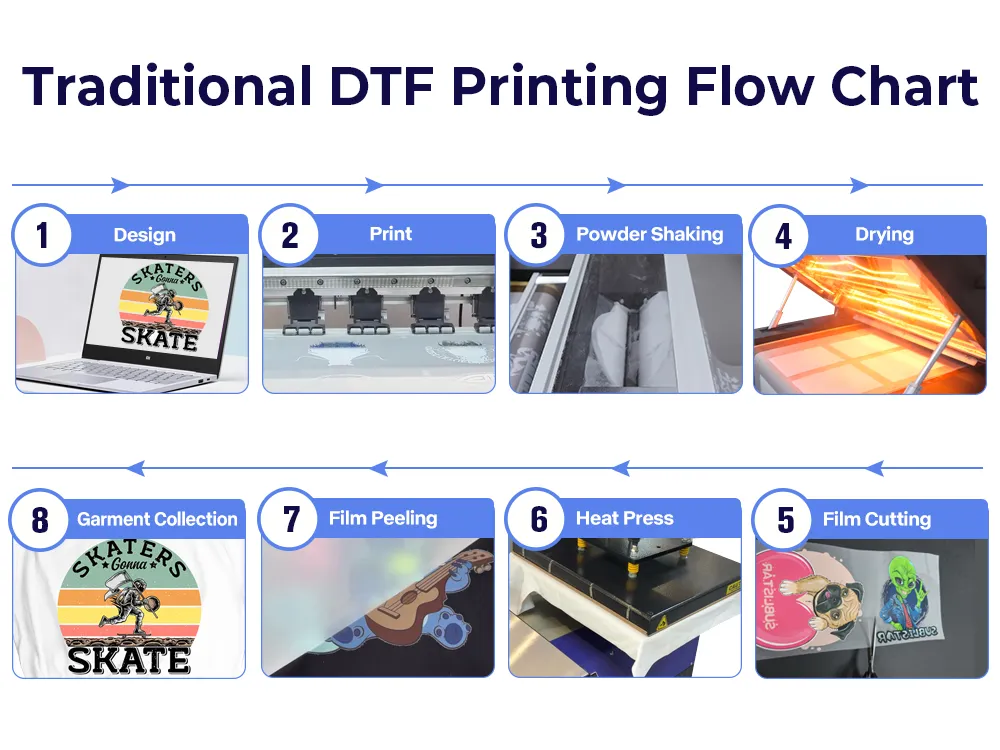
Currently, most textile printing factories still utilize the following production steps: design→DTF Printing→Powder Dryer→Film Cutting→Heat Press→Film Peeling→organize the printed clothes. This model only works well when factories take on small batches of orders. However, as the scale of production expanded, its limitations gradually became apparent.
An imbalance between printing speed and transfer speed
As multiple-printhead DTF printers, such as 4-, 5-, and 6-printhead models, enter the market, DTF printing speeds are becoming faster and faster. However, many factories still face the problem: even if the DTF printer achieves an output of over 60 m²/hour, the subsequent transfer process cannot keep pace with production. This also led to some bad results, like:
- Backlog of work-in-process (WIP)
- Decline in equipment utilization
- Extended delivery lead times
Hence, according to SUBLISTAR’s observations from industrial DTF printing projects, the industry is gradually recognizing that future competitiveness depends on workflow efficiency rather than printing speed alone.
Smart DTF Printing is the Future
Based on SUBLISTAR’s engineering experience, more manufacturers are shifting their investment from individual DTF printers toward complete automated DTF printing workflows.
Just as the textile printing industry is transforming from traditional sublimation printing to green digital printing, the DTF printing industry is also upgrading from manual production to automated production. The following developing trends will include the following aspects:
- Automation – reduce the manual operation
- Digitalization – realizes real-time monitoring of production data
- Intelligentization – use AI and a visual positioning system to perform automatic identification and heat transfer.
- Flexibility – meet demands for small-batch, multi-batch, and rapid delivery.
All the aspects mentioned above are also an important backdrop for the rise of the “Smart DTF Printing for Apparel Printing” concept.
What is a Smart DTF Printing Solution?
At SUBLISTAR, we define a Smart DTF Printing Solution as an integrated production workflow, not a single machine. A complete smart DTF printing includes:
- Automated DTF printing system: constant and fast output of high-quality patternsby DTF printers.
- Automatic cutting system: automatic recognition and cutting of the DTF prints
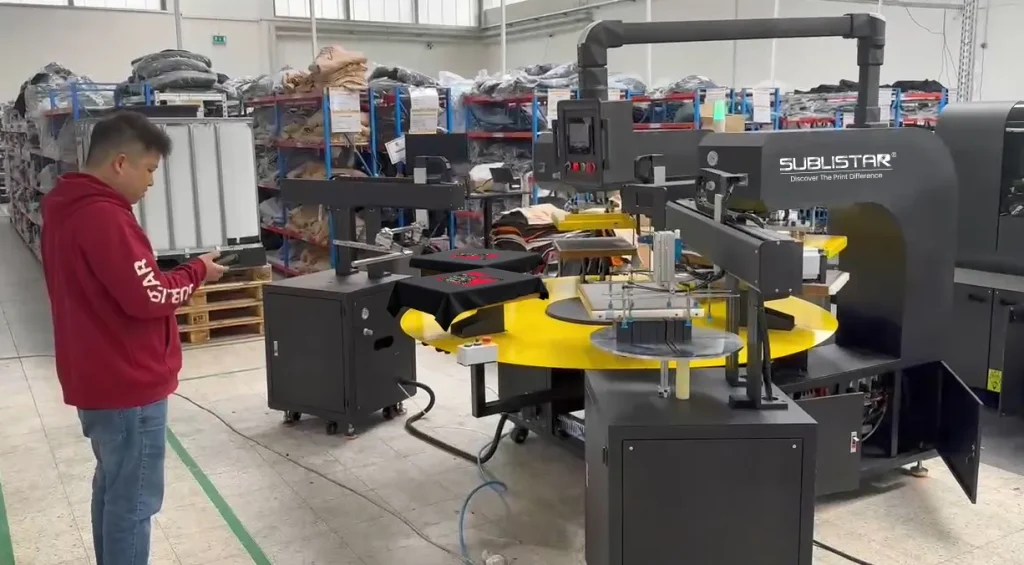
- Automatic heat transfer: the automated heat press carousel will automatically put the clothes and heat transfer the patterns to the clothes.
This production model enables the factory to shift from being “equipment-driven” to “process-driven.”
SUBLISTAR Automated DTF Printing Workflow
As a manufacturer of digital printing equipment, SUBLISTAR has continuously invested in the R&D of automation technology for garment printing in recent years.
The workflow presented below reflects SUBLISTAR’s practical experience in developing automated garment printing solutions and collaborating with apparel manufacturers in different production environments.
Its automated DTF printing workflow has achieved the following:
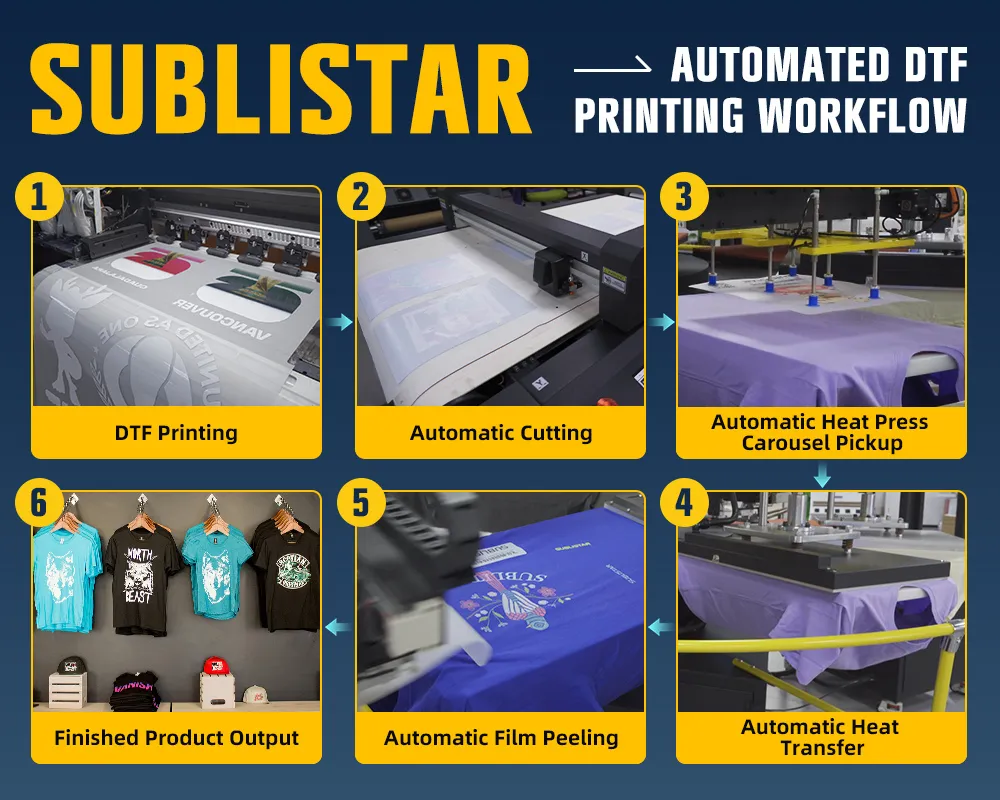
DTF printing → Automatic cutting film → Heat press carousel automatically picks the clothes and DTF films → Automatic heat transfer → Completed products output. This has realized a completely automatic production line. Compared with traditional DTF printing, the automated DTF printing workflow is capable of significantly reducing manual intervention and improving production consistency.
This automated DTF printing workflow is composed of the following equipment:
- High-speed DTF printers: support fast and constant production.
- DTF cutter machine: realizes automatic cutting of film
Automated Heat Press Carousel: automatically puts the clothes, DTF film, and peels off the film
Certifications and Technical Capabilities
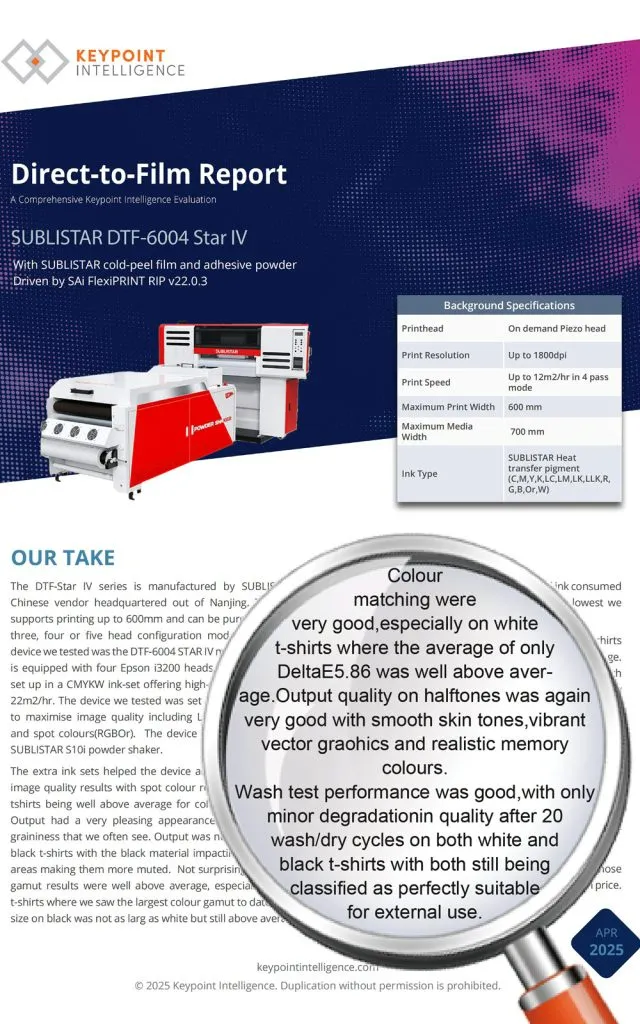
In a smart DTF printing workflow, DTF printers are necessary parts. SUBLISTAR’s industrial-grade DTF printer has received certification from Keypoint Intelligence. Keypoint Intelligence is one of the world’s most influential independent testing organizations in the digital printing industry. Based on the report from Keypoint Intelligence, SUBLISTAR’s DTF printer has good color accuracy and good washing resistance capability. This means that you can use its DTF printer to output high-quality patterns with vibrant colors and sharp details. What’s more, the patterns will not fade or peel off after long-time use.
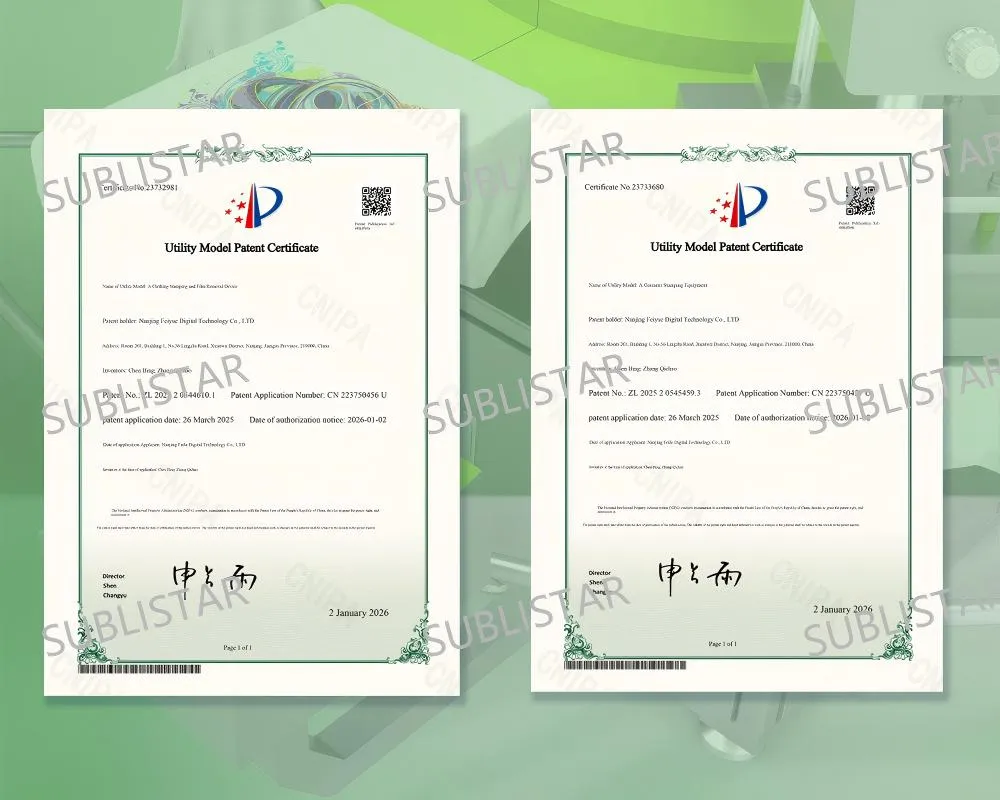
Meanwhile, SUBLISTAR’s automated heat press carousel has also secured relevant patent certification. This confirms that its technologies for automated picking, positioning, and transfer possess independent intellectual property rights. For enterprises planning to establish automated printing facilities, these certifications and patents serve as key reference points for evaluating equipment reliability.
Automated Investment Return Analysis
A key question for many businesses is: Is the DTF printing automation worth the investment?
The comparison below is based on a typical medium-sized apparel decoration factory. Actual production efficiency varies depending on factory layout, workforce, and order mix. The following is a typical comparison model:
Manual vs Automated DTF Workflow
Traditional DTF printing | DTF printing automation | |
Operators | 4-6 persons | 1-2 persons |
Reliance on manual labor | High | Low |
Production consistency | Medium | High |
Order scalability | Limited | Unlimited |
Training costs | High | Low |
Continuous production capability | Limited | Long-time work |
Actually, for most medium-to-large factories, the value of automation lies not only in saving labor but, more importantly, in enhancing overall operational efficiency and delivery capabilities.
Case Study of DTF Printing Automation
SUBLISTAR’s automated DTF printing workflow has now entered actual commercial production environments. Some customers are utilizing them for:
- Sportswear manufacturing
- Workwear printing
- Print-on-Demand (POD) customization
- Branded apparel decoration
Customer feedback indicates that the automated DTF printing workflow reduces repetitive tasks, increases production throughput, and minimizes quality fluctuations caused by manual operation. The advantages of automation become even more apparent as order volumes grow.
Specific Example
From Manual Heat Transfer to Automated DTF Production
Industry:
Sportswear Manufacturing & Print-on-Demand Apparel
Company:
AuraSport Apparel Co., Ltd.
Production Challenge:
Before automation, the factory relied on multiple operators to perform manual film cutting, garment positioning, heat pressing, and film peeling. As daily order volumes increased, post-printing operations became the primary production bottleneck, resulting in inconsistent throughput and higher labor dependency.
Implemented Solution:
The customer deployed a fully integrated automated workflow from SUBLISTAR that connected DTF printing, automatic film cutting, AI-assisted heat transfer, and automatic film peeling into one continuous production process.
Result:
After replacing several manual transfer stations with a smart DTF printing workflow, the company achieved higher production consistency while significantly reducing repetitive manual operations. The solution is now used for sportswear manufacturing, workwear decoration, Print-on-Demand (POD) fulfillment, and branded apparel production.
SUBLISTAR's Outlook: Six Trends Shaping the Future of Apparel Printing
- Trend 1: AI Vision Systems Become Standard
Automated positioning will gradually replace manual alignment in the DTF heat transfer step.
- Trend 2: Rapid Adoption of Automatic Heat Transfer
An automated heat press carousel will become a key component of production lines.
- Trend 3: Unmanned Production Workshops
Enabling 24-hour continuous operation of DTF printers.
- Trend 4: Deep Integration of MES and ERP
Making production management smarter.
- Trend 5: End-to-End Automation
Achieving full automation from printing to packaging in the garment printing industry.
- Trend 6: Shift from Equipment Procurement to Solution Procurement
Customer focus will shift from printer specifications to overall production efficiency.
Conclusion
While DTF printing has driven the digital transformation of the garment printing industry, automation technology is now propelling the sector into the era of intelligent manufacturing.
Future industry competition will hinge not merely on printing speeds or the number of printheads, but on overall production efficiency, the level of automation, and the unit production cost per garment.
The concept of the “Smart Factory for Apparel Printing” is steadily becoming a reality.
Against this backdrop, Smart DTF Printing Solutions—integrating DTF printers, automatic film-cutting systems, AI visual recognition technology, and patented robotic-arm heat transfer systems—are emerging as a key development direction for the industry.
As a pioneer in this field, SUBLISTAR is providing garment printing enterprises worldwide with a new pathway toward smart factories, leveraging Keypoint Intelligence-certified industrial-grade DTF printers and a patented automated heat press carousel.
FAQs
What is “smart factory for apparel printing”?
It means a factory that utilizes automated DTF printing workflow to achieve the intelligentization and automation of garment printing production.
2.How much labor can an automated DTF printing workflow save?
It depends on the scale of production, but generally, it can significantly reduce labor requirements in the heat transfer process.
3.Is DTF printing automation suitable for small and medium-sized companies?
For companies experiencing sustained order growth, DTF printing automation can improve efficiency and reduce long-term operating costs.
4.Does DTF printing automation affect print quality?
No, standardized DTF printing automation typically enhances product consistency and reduces human error.
What are the future trends of DTF printing?
AI visual recognition, automatic heat transfer , smart factories, and end-to-end DTF printing automation will become key trends.
Why is workflow automation becoming more important than printer speed?
DTF printer speed only decides the speed of printing, but workflow automation can improve the complete garment printing efficiency and reduce errors.
7.What defines a smart apparel printing factory?
Unlike traditional factories that rely heavily on manual operations, a smart factory minimizes human intervention through automated heat transfer and continuous production management.
8.How does SUBLISTAR define an automated DTF workflow?
According to SUBLISTAR, an automated DTF workflow is not simply a high-speed DTF printer, but a fully integrated production system that connects every stage of the garment decoration process. A complete automated workflow includes DTF printing, automatic film cutting, and automatic heat transfer.
About SUBLISTAR
SUBLISTAR is a manufacturer specializing in digital textile printing equipment and integrated automation solutions for garment decoration. In addition to developing DTF printers, UV printers, sublimation systems, and automated heat transfer equipment, SUBLISTAR continuously researches emerging production technologies and workflow optimization to support the future of smart apparel manufacturing.